
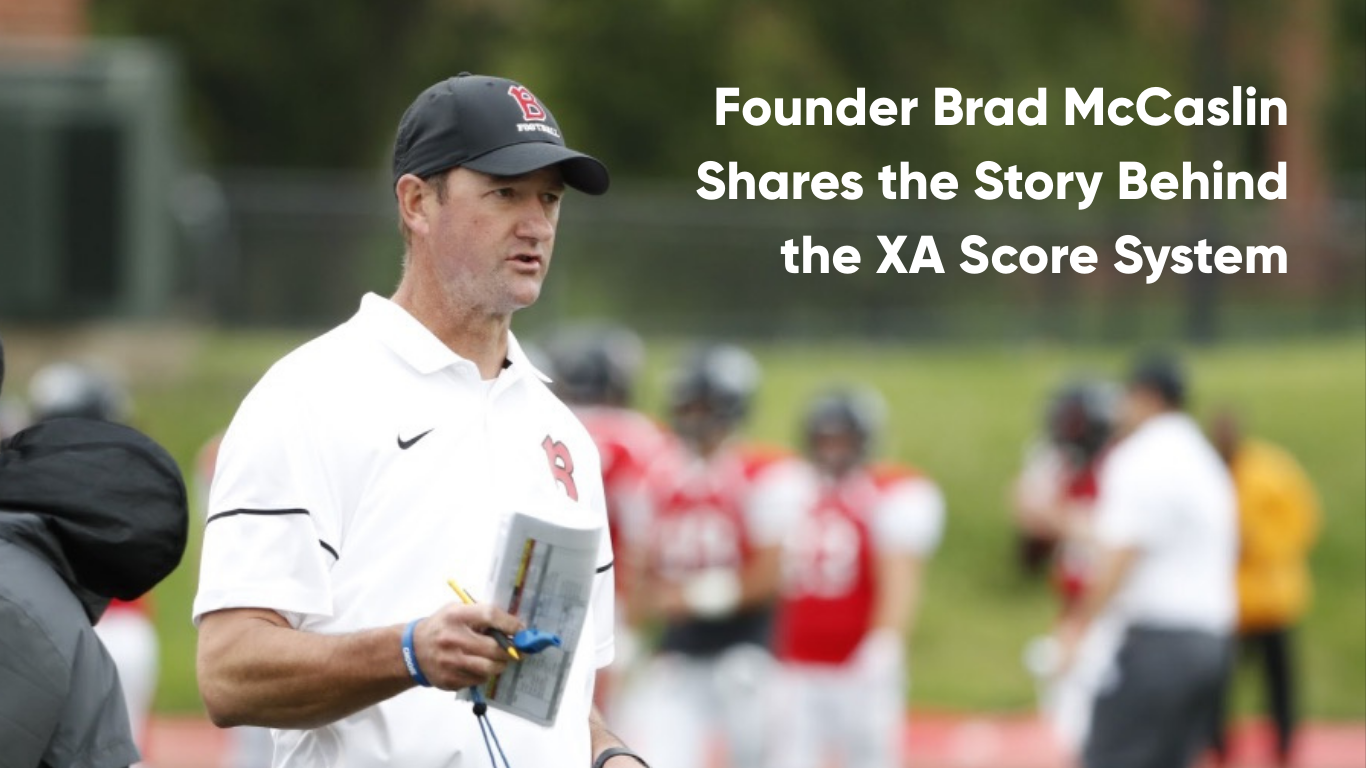
OMAHA, NE. — November 26, 2025 — After more than two decades in college football, Brad McCaslin has a simple mission: help athletes everywhere sleep better and give coaches a more transparent window into what their athletes are really carrying.
“Everything gets better in their world when they sleep better,” McCaslin said. “But for most of my career, I was coaching blind. I couldn’t see what they were dealing with outside the lines.”
McCaslin, a longtime college coach and now Founder of XA Score, grew up on football and the rhythm of showing up, failing, learning, and stepping back into the drill. By his count, he “got back in line” roughly 20,000 times before the age of 22. A repetition that shaped not only how he sees athletes, but how he understands adversity itself.
That perspective deepened during his 14-year run at the University of Nebraska Omaha, where he rose from graduate assistant to defensive coordinator and assistant head coach before the football program was abruptly shut down in 2011, leaving more than 130 players and staff without a team.
“That day at UNO changed me,” McCaslin said. “I was shocked to see how fast everything can be taken away from so many people who poured everything into something bigger than themselves. It made me even more committed to the profession and to the people in it.”
From there, McCaslin went on to Drake University and then Eastern Michigan, where he was part of one of the toughest rebuilding jobs in FBS football. However, the brightest experience during that stretch was the opportunity to recruit future NFL pass rusher Maxx Crosby.
“I’ll never forget receiving Maxx’s commitment on July 4, 2014, while sitting on the deck of my wife’s family farm,” McCaslin said. “I believed in his ability immediately, but what I learned later is that talent is never the whole story. What athletes are carrying, what they’re recovering from, the weight they don’t talk about. That’s where the real battles are.”
Crosby has since been vocal about his off-the-field struggles, including addiction, anxiety, and the toll that poor sleep and mental health took on him. McCaslin is clear that he had no role in Crosby’s recovery, but says hearing his story years later reshaped how he thought about athletes.
“His story was very eye-opening to me,” McCaslin said. “I didn’t know what he was going through at the time. I didn’t know the battles he was fighting quietly. And that’s exactly why athletes need an outlet. They need a safe way to say, ‘I’m not okay,’ without having to walk into your office and force the words out. Stories like Maxx’s remind me how much we miss when we assume everything is fine.”
Coaching Blind vs. Coaching Informed
When you step out of the everyday grind of coaching, you finally get the space to reflect. Raising three athletes at home only sharpened that perspective. From that zoomed-out view, McCaslin started to see something clearly: we were missing too much. Too much sleep deprivation. Too much quiet stress. Too many kids carrying things we never saw.
Part of that realization came years after recruiting Maxx Crosby. McCaslin believed in his ability long before he committed to Eastern Michigan, but what he didn’t know then was the private battle Maxx was fighting. A battle he’s since spoken about with courage and honesty in hopes of helping others. Hearing his story later forced McCaslin to confront how many athletes he’s coached who may have been fighting similar battles in silence. “It made me think hard about the moments I missed, the conversations that never happened, and how many kids desperately needed an easier way to say, “Coach, something’s wrong.”
That reflection, paired with a simple, uncomfortable question a mentor once asked McCaslin, “When you’re in a difficult situation, what would a better coach do?”, made the picture even sharper. Most of us are coaching blind.
McCaslin now uses a scenario with coaches that every staff member can recognize:
You’re watching your team warm up. One of your athletes is off. They’re flat, unfocused, not themselves. You don’t know they’re sleep-deprived, dehydrated, and sore. Practice starts. They miss assignments. They drag through drills. Frustration builds, for you, for them, for their teammates.
In that moment, without context, it’s easy to decide they don’t care, or they’re not working hard enough, or they need to be kicked out of practice. All of the possible decisions are without the full picture of the athlete’s state. It’s coaching blind.
“Now imagine you find out two days prior that they got a call that their dad was diagnosed with cancer,” McCaslin said. “They haven’t eaten right, haven’t slept, haven’t recovered. What would a better coach do then? And what if you already kicked them out of practice?”
“That gap between what we see and what’s really going on stayed with me,” he added. “We tell kids to be honest, but we also celebrate toughness and staying quiet. So they say, ‘I’m good, Coach,’ even when they’re not. I realized we weren’t giving them an easy first step toward help. I built XA Score because coaches can’t support what they can’t see, and athletes shouldn’t have to struggle in silence.”
Sleep as the Starting Point
In recent years, McCaslin has become laser-focused on the factor he now believes shapes everything for athletes: sleep. When he began tracking sleep across multiple football programs, even during improved weeks, it was rare to see an average of eight hours.
“That’s a performance problem. That’s a mental health problem. And honestly, that’s a coaching problem,” McCaslin said. The sleep science is clear. Student-athletes need 9–10 hours of rest for full physical, mental, and emotional recovery. A couple good nights a week can’t undo the chronic stress of all the others. Research shows athletes sleeping less than eight hours a night are 1.7 times more likely to be injured.
And it’s not a just an athlete problem. It was a pattern he’d unknowingly coached through for years. “When I look back now, I cringe at how many mistakes I made simply because I wasn’t rested. Communication, clarity, problem-solving, how I handled adversity,” he said. “So much was left on the table. I see it now in athletes, and I see it in coaches.”
“Coaches grind from dark to dark, and our athletes too often don’t prioritize sleep,” McCaslin added. “But no amount of toughness or grit can overcome poor sleep.”
That conviction, and the belief that coaches must model what they expect, also led to the Winning Edge Network, where McCaslin now shares simple, daily habits such as delaying caffeine, hydrating with intention, protecting the hour before sleep as tools to help coaches sharpen their own readiness and model better habits for their teams.
What XA Score Actually Does
XA Score is a daily check-in system built by a coach for coaches. Athletes complete a quick, mobile check-in that surfaces key readiness signals, including sleep, soreness, and stress, in real time. Coaches receive a daily list of athletes who may need a conversation, a quick adjustment, or deeper support.
What began as a way to simply track attendance and turn “showing up on time” into a discipline score evolved into something much more profound.
“In trying to measure readiness, we unlocked connection,” McCaslin said. “XA Score speaks the athlete’s language. They’ll tell the app things they won’t say walking into your office. When they use it, they’re essentially giving you permission to lean in and ask, ‘What’s going on?’”
Those conversations range from small, a sore shoulder, a bad night’s sleep, trouble with a class, to life-altering.
“We’ve seen everything from ‘I need a better pillow’ to situations where an athlete was in a really dark place and needed immediate help,” he said. “XA Score didn’t fix it. But it opened the door so a coach could step in.”
Today, XA Score is being used across multiple sports and levels, from Power Five football programs to NAIA and high school teams, as well as volleyball, wrestling, basketball, and soccer.
Caring for Athletes — and for Coaches
McCaslin has also written about the “cost of good coaches stepping down,” pointing to the toll the profession takes when coaches are exhausted, unsupported, and expected to give more than they’re allowed to recover from.
“In this profession, what these guys balance between the expectations of the outside and the true calling of job is simply amazing! I fully understand they are expected to win and please those who support their programs. But their first job is develop young people. Those two cannot go hand in hand at all times. And that takes a toll,” McCaslin recently wrote referring to his friend, KU Head Football Coach, Lance Leipold and his comments about Chris Kleiman, Head Football Coach at Kansas State.
“I still believe the most important role we have as coaches is to help athletes overcome adversity,” he said. “To do that, we have to understand what they’re dealing with. Not pretend they’re okay and disregard signals to the contrary. And we can’t do that well if we’re burned out and half-asleep ourselves.”
Through the Winning Edge Network, McCaslin now shares short, practical drills that help coaches build their own habits around sleep, focus, and recovery, translating research and ideas from outside sport into something coaches can actually run tomorrow.
“Winning Edge is about equipping coaches with simple, proven habits that raise standards, sharpen creativity under pressure, and multiply impact,” he said. “XA Score is about giving them a daily window into their athletes’ world. Together, those two things can change how a program feels from the inside out.”
A Coach-to-Coach Invitation
McCaslin is clear that XA Score isn’t about technology. It’s about timing, and giving athletes a daily outlet they’re comfortable using. It opens the door sooner, giving coaches better information so the real conversations can actually happen.
“Trust is the center of every successful program, at any level,” he said. “XA Score just helps you earn that trust a little faster, with a little more clarity, so you can be the better coach your athletes need. Especially on the days they can’t say the words, ‘Coach, I’m not okay.’”
Coaches who want to learn more about XA Score or connect with McCaslin about the Winning Edge Network can visit xascore.coach and start a conversation about what daily readiness and better sleep could look like in their own program.
About XA Score
XA Score is a coach-built daily check-in system that helps teams track sleep, readiness, and simple habits that drive performance and connection. Founded by longtime college football coach Brad McCaslin, XA Score is used by programs across multiple sports and competitive levels to create earlier, better conversations between coaches and athletes.
What’s a Rich Text element?
The rich text element allows you to create and format headings, paragraphs, blockquotes, images, and video all in one place instead of having to add and format them individually. Just double-click and easily create content.
- ffghfgh
- sfghsfghs
- fghh
- sdfhsfghsdfghsgf
- sghsfgh
- sfghsfgh
- sgfh
Static and dynamic content editing
A rich text element can be used with static or dynamic content. For static content, just drop it into any page and begin editing. For dynamic content, add a rich text field to any collection and then connect a rich text element to that field in the settings panel. Voila!
How to customize formatting for each rich text
Headings, paragraphs, blockquotes, figures, images, and figure captions can all be styled after a class is added to the rich text element using the "When inside of" nested selector system.

