
For more than 40 years, the NFL has quietly run one of the largest performance experiments in sports, including work later extended by Dr. Cheri Mah.
The results are hard to ignore.
Across four decades of data, West Coast NFL teams have been roughly twice as likely to beat East Coast teams in night games. This pattern has held through rule changes, roster turnover, coaching eras, and even when oddsmakers account for which team is “better” on paper.
This isn’t about talent. It’s about timing. It’s about awareness. It’s about ownership.
When the lights turn on at night, teams whose body clocks are aligned with the moment consistently perform better. Over time, that advantage shows up in wins, losses, and playoff outcomes.
That’s not theory. That’s decades of results.
And for coaches at every level, it raises an important question: If sleep timing can tilt outcomes in the NFL, what kind of leverage are we leaving on the table at the college level?
The NBA Confirms the Same Pattern
Dr. Mah was asked to study the NBA, and over a three-year period, she became “86% correct on accurately predicting at predicting when an NBA team would be at the highest risk of losing strictly based on their sleep.”
The NBA, where ESPN and the NBA partnered with Dr. Cheri Mah to analyze multiple seasons of schedule density, travel, and fatigue. ESPN termed the resulting fatigue-risk model the “Mah Score,” reflecting how consistently it predicted underperformance in high-risk situations.
At the time, dense travel schedules, late arrivals, and short recovery windows occurred more often. When fatigue is high, performance drops, decision-making slows, and comebacks become rare.
In high-fatigue situations, NBA teams are dramatically less likely to recover once they fall behind. Not because they suddenly forget how to play, but because tired brains and bodies don’t respond the same way under pressure.
Different league. Same conclusion.
Sleep and recovery don’t just affect how athletes feel. They affect what happens when the game is on the line.
One Hour Changes the Speed of the Game
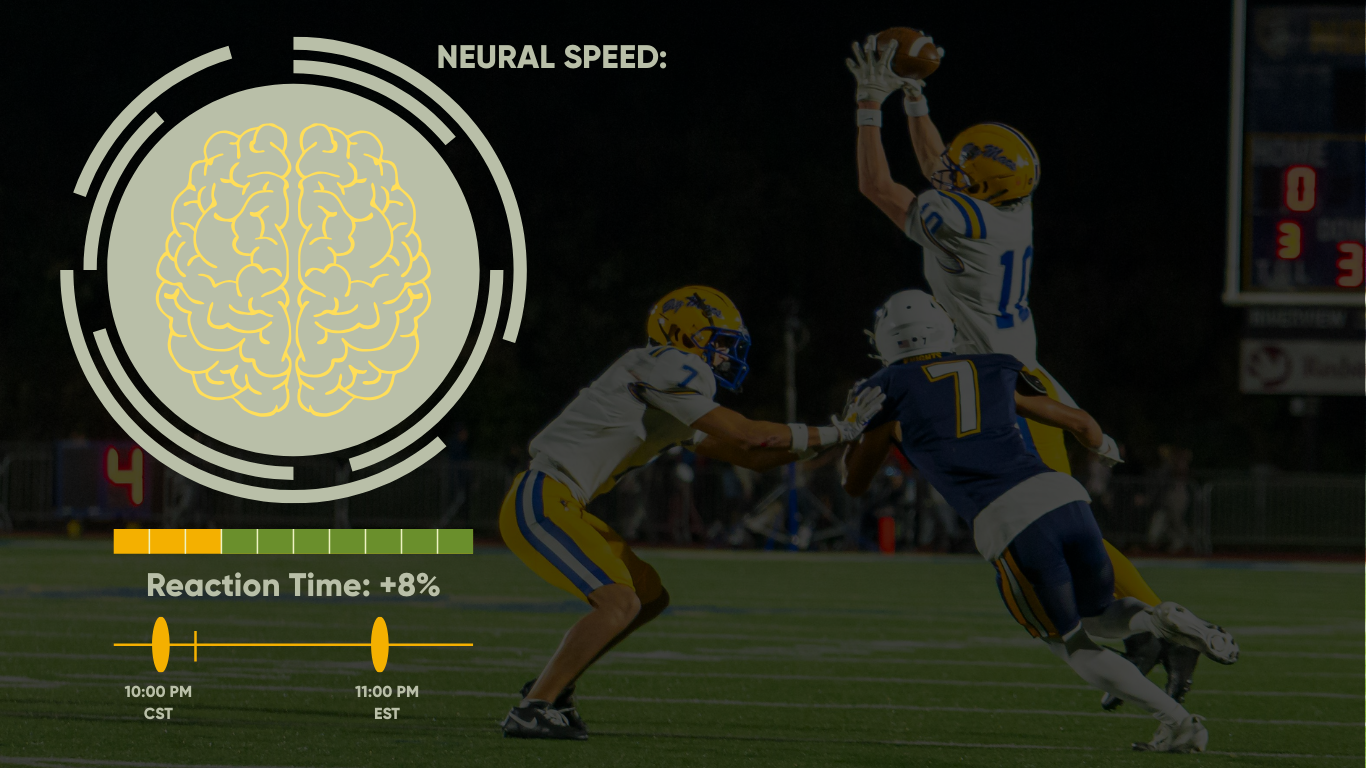
When we talk about sleep, we’re not talking about comfort. We’re talking about neural speed.
Research on trained athletes shows that adding roughly one extra hour of sleep per night across several consecutive days leads to measurable improvements in:
- Reaction time
- Visual recognition
- Cognitive processing speed (decision-making)
These improvements aren’t abstract. We’re talking about fractions of seconds, or the difference between:
- recognizing a coverage rotation,
- reacting to a deflection,
- or choosing the right option under pressure.
In football terms, this shows up as:
- faster reads,
- cleaner decisions,
- fewer mental errors,
- better execution late in games.
And the key point for coaches is this: Sleep is a trained skill. These gains come from small, consistent changes. Not perfection.
Sleep and Availability: The Injury Connection
Performance only matters if athletes are available.
Athletes who consistently sleep eight hours or more per night are significantly less likely to be injured than those who don’t. In some studies, the difference is striking. Injury risk drops by more than 60%.
This isn’t because sleep makes athletes soft or fragile. It’s because sleep supports:
- tissue repair,
- motor control,
- reaction accuracy,
- and decision-making under fatigue.
Missed sleep increases:
- late reactions,
- poor movement choices,
- and breakdowns under load.
From a coaching perspective, sleep isn’t just about performance ceilings. It’s about keeping your best players on the field.
Coaching the Margins: Where Leverage Lives
This isn’t an article about how bad everyone is at sleeping.
Coaches already believe in the power of getting a little better each day. We talk about stacking days, stacking habits, and building momentum through small wins.
Sleep fits that model perfectly. Here’s the leverage question we should be asking:
What happens if the majority of our athletes get just 30–60 more minutes of sleep each night?
Not all at once. Not perfectly. But consistently. Over weeks and months, that shift compounds:
- faster reactions,
- better decisions,
- fewer injuries,
- better energy late in games,
- and more consistent performance across the season.
Sleep is leverage. The NFL and NBA data suggest that timing advantages alone can tilt outcomes. When those advantages are stacked across an entire roster, the effect isn’t small.
This is why the best programs don’t just talk about sleep, they coach it, the same way they coach any other performance behavior.
The Sleep Environment: Teaching Ownership, Not Rules
One of the biggest opportunities for coaches is helping athletes become aware of what a good night’s sleep actually requires.
Sleep doesn’t start when the lights go out. It starts with the environment. Small changes matter:
- darker rooms,
- cooler temperatures,
- quieter spaces,
- phones out of reach,
- consistent wind-down routines.
When athletes understand how their environment affects their sleep, something important happens: ownership increases.
Instead of being told what to do, they begin to:
- notice patterns,
- connect sleep to how they feel and perform,
- and take responsibility for their recovery.
That ownership compounds over time, and it lasts longer than any rule or policy.
Moving the Needle Without Overhauling Everything
The takeaway isn’t that sleep needs to become another overwhelming program.
It’s that sleep is one of the highest-leverage variables we can influence without changing practice plans, playbooks, or training volume.
We don’t need perfection. We don’t need eight hours from everyone tomorrow. We don’t need to track every minute. What we need is:
- better awareness,
- better environments,
- more consistent bedtimes,
- and intentional conversations around recovery.
When athletes understand that sleep is a performance lever, not a wellness lecture, behavior starts to change. And when behavior changes, results follow.
We can actually move the needle here, starting this week, without overhauling everything. Have the conversation. Teach the environment. Watch athletes take ownership. When they connect better sleep to their own performance, the change lasts. That’s the opportunity, and the edge.
Sources & Influences
This article draws from decades of applied research in elite sport, including work by Dr. Cheri Mah on sleep extension, travel fatigue, and performance in professional athletes, as well as broader sleep science contributions from researchers such as Dr. Matthew Walker and others studying the relationship between sleep, cognition, injury risk, and decision-making under pressure.
What’s a Rich Text element?
The rich text element allows you to create and format headings, paragraphs, blockquotes, images, and video all in one place instead of having to add and format them individually. Just double-click and easily create content.
- ffghfgh
- sfghsfghs
- fghh
- sdfhsfghsdfghsgf
- sghsfgh
- sfghsfgh
- sgfh
Static and dynamic content editing
A rich text element can be used with static or dynamic content. For static content, just drop it into any page and begin editing. For dynamic content, add a rich text field to any collection and then connect a rich text element to that field in the settings panel. Voila!
How to customize formatting for each rich text
Headings, paragraphs, blockquotes, figures, images, and figure captions can all be styled after a class is added to the rich text element using the "When inside of" nested selector system.

